Planting in Rugby

Trees, Shrubs and Borders Planted Across Rugby

Trees, hedging, shrubs, perennials and beds planted across Rugby.

From £200 per planting brief Hedging usually £25–£45/m. Specimen trees £150–£800 each planted. Borders quoted bespoke.

5.0★
Rating
Google verified
£5m+
Insurance
Public liability cover
BS3998
Standard
British tree work standard
CV21/22/23
Coverage
Rugby & surrounding villages

Every planting job comes with…

  • Bare-root and container-grown trees and shrubs
  • Hedging, mixed native, beech, hornbeam, laurel, yew
  • Perennial border installation
  • Soil improvement and ground preparation
  • First-season aftercare advice and watering plans

What we plant

Our planting work splits into four categories:

  • Trees: specimen ornamentals (rowan, cherry, magnolia, crab apple), fruit trees (apple, pear, plum), structural natives (oak, hornbeam, beech), bare-root or container-grown
  • Hedging: native mixed (hawthorn/blackthorn/field maple), beech, hornbeam, laurel, yew, pleached or instant hedging panels
  • Shrubs and structural planting: backbone shrubs, foundation planting, evergreen structure
  • Perennials and borders: naturalistic mixed borders, prairie schemes, cottage borders, herb gardens

We source from reputable Warwickshire and Midlands nurseries, not garden-centre stock and not online specials. Provenance matters for hedging especially: native plants from local seed sources establish 30–50% faster than imported equivalents.
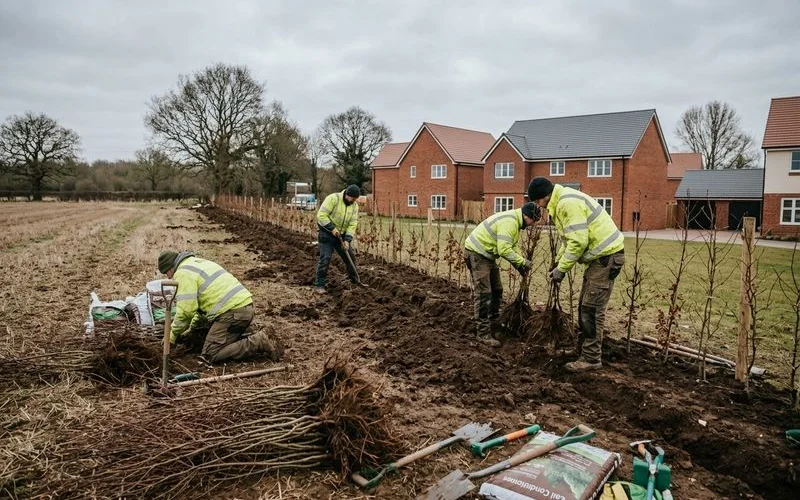
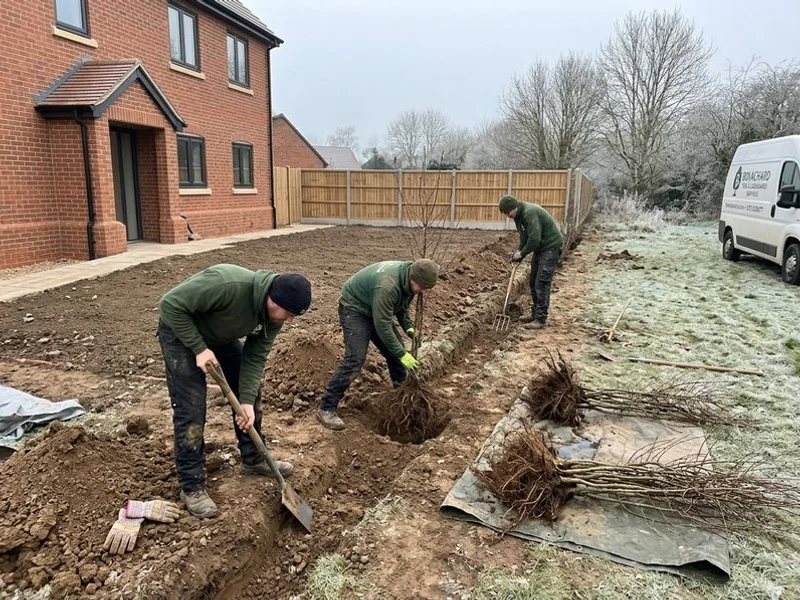
Bare-root hornbeam hedge being planted along a Cawston new-build boundary in winter dormancy

Bare-root timing for Warwickshire

If you can plant trees and hedging in dormancy, you should. Bare-root planting (Nov 1 – Mar 1 in Warwickshire) gives you:

  • Bigger plants for the same money: a 60–90cm bare-root hawthorn whip is half the price of an equivalent container-grown plant
  • Faster establishment: bare-root roots settle and start working immediately on planting; container-grown plants spend their first season transferring out of pot soil
  • Better hedging density: closer planting (5/m or even 7/m for thicker hedges) is affordable with bare-root pricing

Container-grown stock plants any time of year, but the best windows are autumn (Sep–Nov) and spring (Mar–May), avoiding summer heat that stresses freshly-planted root balls.

We schedule large hedging and tree planting briefs around the bare-root window where the project allows. If a garden landscaping project lands in summer, we plant container-grown structural shrubs immediately and slot the bare-root hedge in over the following winter.

Soil prep, especially on new-build estates

Most planting failures are soil failures. The biggest culprit in our area is new-build subsoil. Cawston, Cawston Grange, parts of Bilton, these estates have:

  • Compacted subsoil under a thin (often 50mm) skim of cheap topsoil
  • Builder rubble (mortar, brick, hardcore) buried in the planting depth
  • Alkaline mortar leach raising pH unpredictably, often 7.5–8.5 vs the 6.5–7.0 that most ornamentals prefer
  • Poor drainage: water sits, roots rot

Our standard new-build soil prep:

  1. Mark out planting zones and excavate to 400–500mm depth
  2. Broadfork the subsoil to break compaction without inverting profiles
  3. Remove builder rubble (mortar, brick, plastic, hardcore) by hand
  4. Add 100mm topsoil rotovated into the upper 200mm
  5. Add 30–50mm organic matter (well-rotted manure or composted bark)
  6. pH correct if needed: sulphur for alkaline soils, lime for acidic
  7. Plant into worked, watered ground

This adds £40–£80 per planting zone vs. just sticking a plant in the existing dirt, and pays back in survival rates.
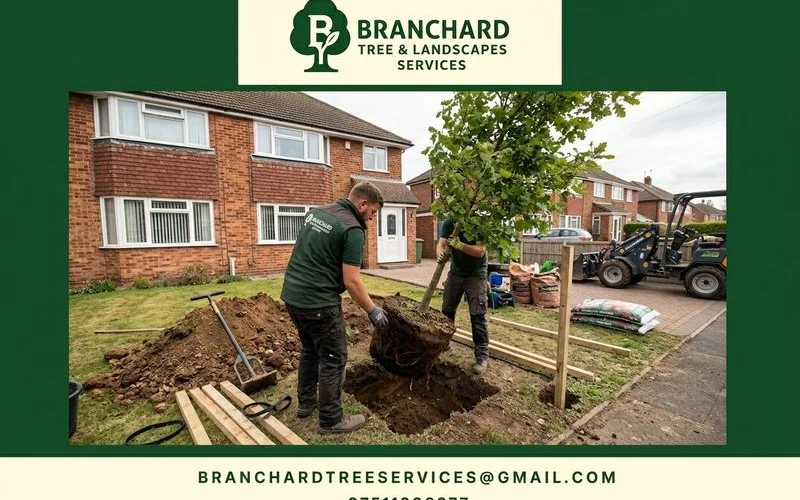
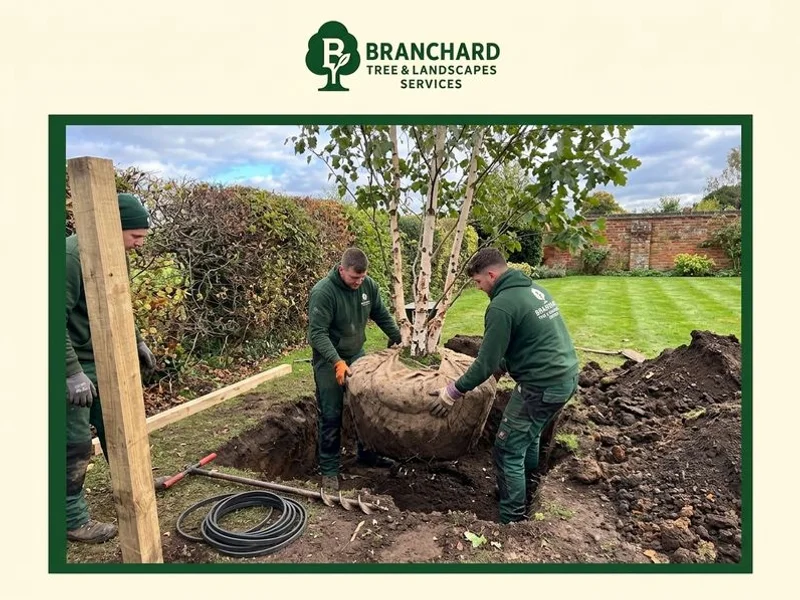
Container-grown specimen tree being positioned in an excavated pit with staking and ties, ready for backfill

Aftercare, the difference between life and death

The first two seasons after planting are when 80% of failures happen. Almost all of them are watering errors, usually too little, occasionally too much. Our written aftercare plan covers:

  • Year-1 watering schedule: deep soak (15–20 litres for a tree, 5L for a shrub) once a week through Apr–Sep, twice a week in heatwaves. Not daily sprinkles.
  • Year-2 watering schedule: deep soak fortnightly Apr–Sep, less in cool/wet summers
  • Mulching cycle: fresh 50mm mulch annually in early spring to retain moisture and suppress weeds
  • Feeding plan: light spring feed in year 2 onwards, no feed in year 1 (encourages soft growth that struggles in winter)
  • Stake removal: tree stakes removed at year 2–3, when the trunk has thickened enough to flex without breaking

We write this down. We hand it over on completion. We chase it up at the 6-month mark if you want a maintenance contract.

Pricing for planting in Rugby

Typical Rugby planting work:

  • Hedging (bare-root, native mixed, 5/m): £25–£35/m
  • Hedging (beech or hornbeam, 5/m): £30–£45/m
  • Specimen tree (planted, staked, mulched, with prep): £150–£800 each
  • Mixed perennial border (10 sqm, design + plants + ground prep): £600–£1,500
  • Soil improvement (per zone, new-build estate): £40–£80 add-on
  • Aftercare maintenance (first season, monthly visit): £40–£80/visit

Talk to the Rugby tree surgery and landscaping team for a free site visit and tailored planting plan.
How planting works with Branchard in Rugby

01

Site visit & soil check

We assess soil, aspect, drainage, light and existing planting before recommending.

02

Sourcing

Plants sourced from reputable Warwickshire/Midlands nurseries, bare-root in season, container-grown otherwise.

03

Ground prep & planting

Soil improved, weed membrane laid where appropriate, planting holes excavated to spec, mulched.

04

Aftercare plan

Written watering and feeding plan for the first two seasons. Optional follow-up maintenance contract.

What does planting cost in Rugby?

Typical range

£200 –£5,000

per planting brief

Hedging usually £25–£45/m. Specimen trees £150–£800 each planted. Borders quoted bespoke.

Get a free written quote

Why Rugby homeowners choose Branchard for planting

Soil-first thinking

Most planting failures are soil failures. We test, improve and prep ground before plants go in, especially on new-build estates with compacted subsoil.

Bare-root timing

Bare-root planting (Nov–Feb in Warwickshire) gives you 30–50% bigger plants for the same money. We schedule around the dormancy window where suitable.

Native and naturalistic

We lean toward native species and naturalistic schemes that suit Warwickshire's soils and climate. Less needy than imported ornamentals, better for wildlife.

Aftercare written down

Watering schedule, feeding plan, mulching cycle, written, dated, on the handover document. No 'just water it occasionally' vague advice.

Ready for a free written quote?

Free site visit. No obligation. Itemised quote within 48 hours, BS3998 compliant and fully insured.

Recent planting jobs across Rugby

What customers say about our planting work

★★★★★
"Full back-garden makeover in Cawston, patio, retaining wall, planting plan. They knew exactly what to do with the rubbish new-build soil and the planting has come away brilliantly."

Tom & Aisha O.

Cawston

★★★★★
"Native mixed hedge along the back boundary, 40 metres of bare-root in February. They're up to my waist already in their second summer. Beautiful work."

Margaret K.

Dunchurch

★★★★★
"Three specimen trees in a small Hillmorton garden, apple, rowan and a small cherry. Properly prepared planting pits, staked and tied, watering plan written down. All thriving."

Richard A.

Hillmorton

Planting FAQs

When should I plant trees and hedging in Warwickshire?
Bare-root trees and hedging plant best November to early March (the dormancy window), bigger plants for less money, faster establishment. Container-grown stock plants any time of year but ideally autumn or spring to avoid summer heat. We plan jobs around the bare-root window where the brief allows it.
What's wrong with new-build garden soil?
Most new-build gardens (Cawston, Bilton estate developments) sit on heavily compacted subsoil with very little real topsoil. Plant roots can't penetrate, drainage is dire, and pH is often skewed by alkaline mortar leach from foundation work. We address this with proper soil improvement: subsoil broadforking, 100mm topsoil rotovated in, organic matter added, sometimes pH correction.
Will my new plants survive the first summer?
First-year plant losses average 10–20% on UK domestic planting; we aim for under 5%. Three things make the difference: proper ground prep (most failures are soil), correct planting depth (a tree planted 50mm too deep is a tree that'll struggle), and consistent watering for the first two summers (deep weekly soak, not daily sprinkles). We provide a written watering plan.
Do you do hedging?
Yes, bare-root native mixed hedging (hawthorn, blackthorn, hazel, field maple), beech and hornbeam (deciduous), laurel and yew (evergreen), pleached hornbeam or lime (formal), instant hedging (1.8m+ supplied as ready-grown panels). Choice depends on light, soil, screening height needed and budget.
Will you replace plants that die?
Plants are warranted for one growing season subject to reasonable aftercare. If a plant fails in year one and you've followed the watering plan, we replace it. We document aftercare at handover so the warranty conditions are clear.
Can you do small planting jobs or only big ones?
We do both, from a £200 single specimen tree planted into a prepared bed, through to a £5,000 mixed border and hedging brief on a full landscaping project. Smallest meaningful job is about £200 (one or two specimen plants). Below that, garden centres and a Saturday afternoon are usually a better answer.

Need planting in Rugby? Get a free quote.

Same-week site visit. Written, itemised quote within 48 hours. BS3998 compliant, fully insured.

BS3998 compliant NPTC certified climbers £5m+ public liability